
After the party's over
What are we going to do now?

Saturday May 22 1976
There are absolutely no games of football to report on this weekend. Well, no games in Scotland or involving Scottish teams at any rate. Welcome to the new-look, summer Bairns O’ The Revolution, now available in three bite-sized chunks each weekend. Very occasionally, I’ll have some football to talk about, but don’t hold your breath.
There’s still plenty of other stuff going on, don’t worry - for example, the quarter-finals of the European Championships happened on Saturday (I refuse to bow to Wikipedia and retrospectively call them Euro 1976). Wales were still part of this, and will no doubt have seen the Home Championships as something of a mixed blessing, since the benefits of having competitive games to tighten up on strategy and so on will have been easily cancelled out by having their exhausted players go through another three whole games before the important one.
2-0 down from the first leg in Yugoslavia, this didn’t end well for the Welsh:

The games was, according to the Sunday Post reports, a “hard, tough, bruising game”, with the Welsh crowd unimpressed by the East German referee. In their defence, he did disallow two Welsh goals, although he was dealing with the natural suspicion of Western audiences to anyone from the other side of the Iron Curtain.
However, the result stood, and Yugoslavia will be hosting the rest of the tournament -all four games of it.1
All four quarter-finals happened on Saturday, and to save you the trouble, here’s the full set of scores. Thanks, Wikipedia.
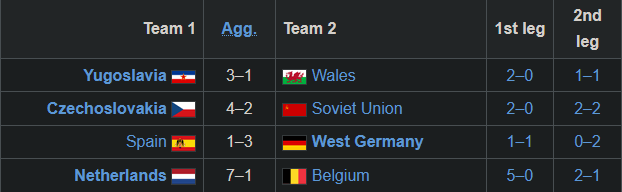
My probably never-to-be-written book about World Cup qualifying2 notes that the Netherlands and Belgium play each other a lot in qualifying campaigns. Belgium used to have the upper hand, but - in spite of providing two of the six European club finalists this year - not any more.
Incidentally, had Scotland somehow out-qualified Spain, I’m not sure I would have fancied our chances against West Germany.
There is, naturally, a lot of football gossip swirling around in the absence of any actual games, including the fact that Jock Stein is off to Spain on holiday, and Queen’s Park manager Davie McParland has been given a job at Celtic Park, but no-one is saying what it is.
Bill McFarlane in the Sunday Post thinks he knows who’s going to take over the vacant Queen’s job:
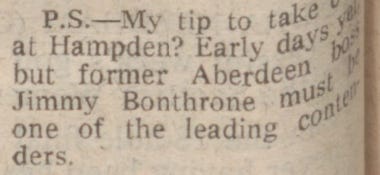
Well, he might be, except he’s now working as a car salesman in Kirkcaldy.
Next Friday sees the all-important Scottish League AGM, where the proposal to scrap relegation from the Premier Division and go to a 12-12-14 setup will be discussed. Or possibly not, since it seems to have no chance of succeeding now. There will also be a recommendation brought forward to raise admission prices for next season.
This means my pocket money will have to go up, so I’m all in favour.
If you’re wondering, prices are set, not by the clubs, but by the leagues. Ah, those innocent days.
One more thing before I move on to Part 2 of this week’s ramblings:
If you look at Page 34 (it’s always on page 34) of the Sunday Post for the scores, you’ll notice a staple of my childhood summers:
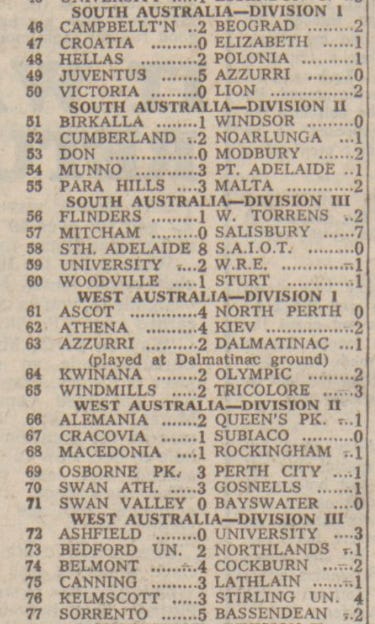
Every Sunday, the papers would print a complete set of Australian league scores. Not because of any lasting interest in the game down under, but because the football pools had to keep going.
I realise that there may be people reading this with no real idea of what the pools were, so a quick recap is in order:
Each week, the various pools companies (Littlewoods, Zetters, Vernons, Empire - there were others, I’m sure) would publish a coupon featuring a list of all the games to be played that weekend. To participate, all you had to do was choose eight games which you thought might end in score-draws, and put down your stake. Pools collectors would go door-to-door, or turn up in pubs, and you could of course fill in your coupon in a betting shop.
The scoring system was way more complicated than I’m making it sound, but the essence was that eight score-draws would earn you 24 points and at least a share of the jackpot. It was part of the fabric of national life, with classified scores eagerly anticipated, and a Pools Panel sitting whenever there were widespread postponements.
The Pools Panel prognostications often clashed with what we, as supporters of clubs involved, might agree with, but fortunately no league was ever won or lost on a Pools Panel decision.
In the summer, with no games to gamble on, the scores from Australia were substituted in. Entire pages in newspapers each week were given over to analysis of which games were likely to end in a draw, but I’ve seen no evidence that anyone writing those articles had the slightest idea what the strengths and weaknesses of the teams involved were - at least in December, a forecast for Scunthorpe versus Carlisle could be based on match reports and the league table.
I promised an update - possibly the final one - on Jim Hermiston, one of my stories of the season. The good news is that, free from the restrictions placed on him by Aberdeen, he played on the winning Grampian Police side in the Scottish Police Challenge Cup final against Lothian and Borders Police - the 1-0 win a fitting end to a turbulent season for Jim.
Below the first line this week; the first of five season reviews, which I’ll do in order of final position.
Rangers
On November 8th 1975, Rangers were in sixth place, albeit only two points off the top. They hadn’t won a Premier Division game in a full month, although there had been a much-celebrated League Cup win over Celtic in that time.
Newspapers were sending correspondents to Ibrox to figure out what had gone wrong with the reigning champions, and the Rangers fans could have been forgiven for wondering if this new-fangled ten team thing was the cause of all the issues.
I will allow that many teams struggled to come to terms with the new setup, and I suspect that Rangers were one of those affected in the beginning. The fact that there were now no games where you could comfortably rest weary players or give youngsters a relatively untroubled run-out affected the bigger clubs more than they expected, and the added pressure of four Old Firm games per season can’t have helped.
However, you do have to admit that Jock Wallace got his act together quickly after November. Rangers lost only two more league games all season, both of them before the end of 1975, and they reached a level of consistency which no-one else could match. Derek Johnstone started banging in goals for fun, and a settled side cruised to both the league title and the Scottish Cup, only the fifth time in history a Scottish side had claimed all three available trophies.3
Player of the year was generally acknowledged to be the veteran John Greig, who seems to have held this all together while making a comeback on the international scene.
Celtic
In the early hours of July 5th 1975, Jock Stein was involved in a car accident on the A74 which came extremely close to killing him. His recovery was slow and painful, and resulted in Celtic being managed by his assistant Sean Fallon for the entire season.
Fallon inherited a squad which had gradually lost all but Bobby Lennox of the Lisbon Lions side which had won the European Cup in 1967; this was a team in transition, and without their guiding force in Stein, one which never seemed to quite get it all together on the field.
The League Cup Final loss to Rangers was not out of the ordinary, but dropping out of the Scottish Cup to Motherwell at the first hurdle, and losing to an unfancied East German side in the quarter-finals of the Cup Winners’ Cup certainly were. There was a feeling around the place that Stein’s presence would have prevented both those exits.
You also suspect that a fully fit Jock Stein would never have allowed his team to fade so definitively at the end of the season - a point clear at the beginning of April, Celtic won only one of their last seven games to finish an unlikely six points behind Rangers.
The team may have been rebuilding, but more will have been expected of them; Stein’s absence cast a long shadow.
Player of the year is undoubtedly Kenny Dalglish, who assumed the captaincy, and often seemed to be playing teams on his own, or at the very least with only Danny McGrain for company. McGrain also had an outstanding season, but the same cannot be said for many of his team-mates.
What’s exercising the front pages of the papers this weekend?
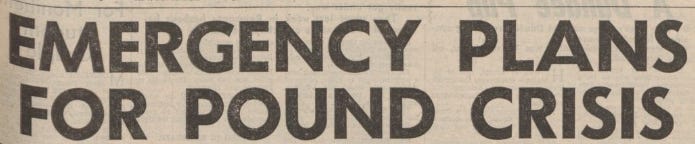
Apparently, there’s a severe economic crisis just around the corner. It’s not clear if this is the same economic crisis which the Sunday Post has been predicting ever since the Labour government was elected in 1974, but I suspect it could be.
You’ll no doubt recall that the sudden, although hardly unexpected, resignation of Jeremy Thorpe as Liberal Party leader has left something of a vacuum at the top of the party. The 13 Liberal MPs now have to come up with a replacement from among their number, and things are not exactly clear. As far as anyone can tell, David Steel, John Pardoe, Emlyn Hooson and now Russell Johnson would all like to take part in any election.
The last time the Liberals elected a leader, there were only 12 of them, and three men stood. Six of the 12 MPs voted for Thorpe, and the other two withdrew, but there was a general understanding that leaving the choice of leader to only 13 people might not appear particularly democratic, especially given what happened to the last leader elected this way.
Therefore, while a third of the eligible parliamentary party jostles for position, no-one actually knows who will be voting and when. There is a suggestion of asking the entire party membership to weigh in, but there is no clear plan at this stage.
In the meantime, Jo Grimond continues as temporary leader, Thorpe remains an MP and can vote for his successor, and no-one in the press knows who has actually put their name forward, or if any of them have been nominated by anyone.
The Labour Party had their election in about ten days a couple of months ago, and the winner of that got to be Prime Minister. Just saying.
You may have forgotten - I know I had - that the UK and Iceland are still embroiled in a ‘Cod War’ - British trawlers are still breaching the Icelandic exclusion zone and are being regularly harassed by Icelandic patrol boats, although there doesn’t appear to be any actual shooting going on.
The positive news is that British Foreign Secretary Anthony Crosland and the Icelandic Prime Minister have been talking. They both claim not to have changed their positions at all, but the media seem to think this is code for “we have actually changed our positions, we just can’t say so”.
Some reports reckon this whole thing could be sorted out within a week. We’ll see.
Oh, and one more thing - if for any reason the Democratic Party in the US fails to elect a Presidential candidate in August, Teddy Kennedy has volunteered to step in. Given the way the primaries are going, this feels more like an attempt by Kennedy to keep his name in the news than anything else, but he’s no doubt aware of how Rangers were being written off early in the season, and look what happened to them.
More Bairns in a week, as I continue my summer schedule.
Including everyone’s favourite thing - a third place playoff
It’s a real thing, but once you get to the 1990s, it becomes massively unwieldy, so it may never get beyond the ‘notes plus some posts on football forums’ stage.
The League Cup didn’t exist before the Second World War, so there had only been 30 opportunities to complete a treble at this point. Celtic had done it twice, the last time in 1968-69; Rangers’ previous treble had been in 1963-64.