
Let's Not Go Round Again
And let's get working on those press-ups while we're about it.

Saturday July 24 1976
One more week to go until Scottish footballers will once again be allowed to be seen in public, and it has to be said, there’s not much going on.
50 years ago, players were registered to their clubs even when out of contract, and as a result, transfers were few and far between; many players simply accepted their lot, bought a house nearby and settled down. Your team’s line-up for the first game of the League Cup groups1 in a couple of weeks will not be radically different from the one which played in the nailbiting last few games of last season.
Even if there had been transfers, it’s likely no-one in the Scottish press reported on them, because all the football writers were either covering golf, tennis or, for the lucky few, the Olympics. Or they were on holiday.
Still, there was one huge event this week to keep us all on our toes: another league reconstruction attempt.
Regular readers will remember that last week’s Sunday Post contained this bold prediction:

Well, Thursday duly arrived, as Thursdays tend to, and this happened:
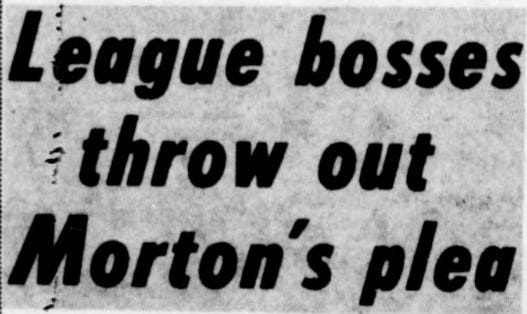
So, what’s going on? Hal Stewart, chairman of Morton, was convinced that everyone outside the top flight was desperate for another change - expanding the Premier Division to 12 teams, and adding two more promotion spots from Division 1 at the end of the coming season to make it happen. Division 2 would be left alone, because no-one cares about those guys - which may well have been part of the problem.
Stewart had been confident going in to the meeting, needing 252 votes in favour to pass his motion. In the end, he scraped together 15. There’s no record of which clubs voted which way, but my guess is that the 14 Division 1 clubs were broadly in favour, one of the more ambitious Division 2 clubs - dare I suggest Dunfermline? - went along with it, and everyone else said “no thanks, you’re alright.”
For Premier Division sides, there would have been no change in jeopardy - two would still have gone down, but the prospect of playing 44 games a season, with all (or almost all) the big names already in the division, was not appealing - whoever came up as the fourth best team from Division 1 was unlikely to add much to the gate receipts, and fitting 36 games in last year proved difficult enough - 44 would likely mean an increase in midweek fixtures, which generally drew smaller crowds and cost more to put on.
Division 2 didn’t seem to feature in Hal Stewart’s plans, and they probably all voted ‘no’ on the basis that they’d quite like to see if the new 39-game schedule was going to work before ripping everything up again.
Hugh Taylor in the Record was pleased:
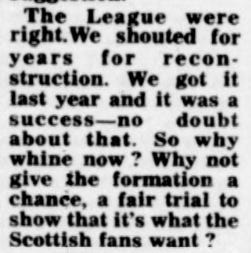
If this is what the fans want - and the jury’s definitely still out on that - the clubs have done us all a favour here - changing everything every couple of years doesn’t sound like a recipe for success.
Little else happened this week - The Green Final reports, no doubt to the horror of 13-year-old me, that Arthur ‘Bumper’ Graham will be allowed to leave if a suitable offer is received, without defining ‘suitable’. Graham is 23 and feels he could be earning more, which is no doubt true for many of his team-mates. Scottish football, however, doesn’t really offer much opportunity for huge hikes in wages, so he’ll likely be looking south.
Not at Second Division Chelsea, however, whose players have apparently volunteered to take a pay cut to keep the club afloat. Scottish manager Eddie McCreadie declared himself thrilled:
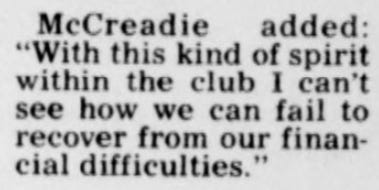
Elsewhere on the sports pages, it has been the first week of Olympic competition. The entire event took up only two weeks, so everything feels like it has been crammed in to the first few days, and while there are many stories to tell, I’m wary of turning this into the Olympics Report, so here are the key highlights:
22 nations eventually pulled out, but some of their athletes hung around hoping to take part as independents. There was no clarity on either side about any of this, but up to now, no-one has been allowed to do this.
In related news, the IAAF finally got round to banning South Africa from all athletic competiton. Britain’s Harold “Chariots of Fire” Abrahams noted that you can’t hope to persuade someone if you don’t interact with them, to which I hope someone else explained that decades of ‘persuading’ didn’t seem to have worked; this is the next step.3
Soviet modern pentathlete4 Boris Onishchenko was disqualified for cheating - during the fencing discipline, his épée was discovered to have a switch on it which allowed him to register a hit5 whether or not contact had actually been made. Onishchenko’s disqualification was a factor in Great Britain’s first gold of the games, which very briefly turned the entire nation into modern pentathlon fans.
Britain’s second gold came late on Saturday night UK time, as Scotland’s6 David Wilkie won the 200m breast stroke in a new world record time.
Princess Anne suffered a concussion which might rule the British team out of the equestrian events. As far as I know, her choice of underwear had nothing to do with this.7
I’d like to tell you that other Scottish sport happened, but other than the Scottish Amateur Golf Championships, it didn’t. I was faintly surprised to note just how many greyhound race meetings were going on - next to the story about the failed reconstruction bid in the Record on Friday, I count twelve different tracks reporting either results from the night before, or line-ups for Friday night.
Ah well, there will be football to report on next week, I’m sure. Until then,
The front pages reflect the reality of life in 1976. Either there’s a feelgood Olympic story to distract us (and justify the expense of having flown entire sports desks out to Montreal), or there’s more economic doom and gloom. Even this week’s political assassination sped by with little fanfare, although I remember it, so let’s start there.
Christopher Ewart-Biggs, the UK ambassador to the Republic of Ireland was killed by a car bomb only two weeks after taking up his position. A bona fide war hero who sported a blacked-out monocle, Ewart-Biggs’ assassination lingered on the front pages for only one day, such was the lack of surprise at such things.
Chancellor Denis Healey and his eyebrows announced a round of public spending cuts which even the left-leaning Daily Record struggled to put any positive spin on. In the normal way of these things, the current government is taking the pain of trying to clear up the economic mess left by the previous one, exacerbated this time round by the general economic slump caused by the runaway price of oil.
Thank goodness that never happens any more, eh?
Friday’s Daily Record devotes a full colour double-page spread to the “astonishing female competitors from the Communist bloc countries in the 1976 Olympics”. The text is vague and generally positive, but does wonder obliquely about “tomboy figures” and “shoulders like weight-lifters”8 without ever suggesting that anything untoward was going on.
They do, however, have a suggestion for any young girls reading as to how they might be able to match these “Iron Maidens”.
Press-ups. No, seriously. Apparently, all that’s standing between British women and the medal podium is a few calisthenics:
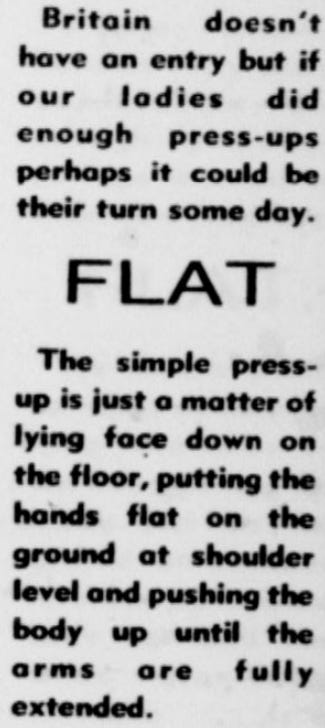
There we are: now we know how it’s done, every medal in 1980 will surely be British.
Sections, sorry - I’m out of practice.
Two-thirds of 37, because Meadowbank still don’t get a vote, obviously.
For younger readers; South Africa’s openly racist Apartheid system had been tolerated for decades; the multitude of independent African nations plus a gradual rise in awareness in the Western nations was beginning to make it one of the key political topics around the world. Not before time.
Has there ever been a more clumsily named sport?
A very palpable hit, as Shakespeare would have it.
How proud of him we were - cheerfully ignoring the fact that he was neither born in, or living in Scotland.
See last week for details.
I mean, maybe they lift weights?