
Nothing Ever Happens
It's quiet. Too quiet...

Saturday June 5 1976
You know it’s summer because the back page of Monday’s Press & Journal is devoted to golf and cricket. Rangers’ win in their final tour match in Toronto gets a paragraph, as does Hearts’ win over a New Zealand “representative XI”1, but that’s about it for football news.
Tuesday brings news of the final games in the the Bicentennial Cup, a four-team tournament being held in the US to mark - well, the clue’s in the name.
The only reason I mention it is that England were playing “Team America”, which was essentially a NASL2 select side, and was captained by Bobby Moore. No, it really did happen. (Warning: links to the FIFA website, in case you’re boycotting that.)
You want to see what that looked like? Of course you do (be aware, this is the entire game, even I drew the line at watching the whole thing):
There is a Scottish connection to this game - if you watch for long enough, you’ll see Team America’s goal being scored by Bo’ness-born Stewart Scullion.
Wednesday saw the 197th running of the Derby at Epsom3, so no papers had room for anything football-related. If you’re wondering, Lester Piggott won on Empery.
Thursday’s P&J has exciting news for Aberdeen supporters, reporting the signing of Stewart Kennedy from Falkirk. Ally MacLeod’s spending spree is calculated to have reached £120,000, which is close to the amount received for Willie Young back at the beginning of the season, so I doubt there will be much more activity this summer.
The only news which reached Thursday’s back pages was the confirmation that Davie McParland, who joined Celtic a couple of weeks ago, will indeed be replacing Sean Fallon, who led the team through the entire 1975-76 season, but has now been moved to a scouting role. With Jock Stein restored to first-team duties, however, McParland’s job will likely involve a lot of agreeing with whatever his new boss says.
Friday brought news that the English leagues were going to emulate the Scottish ones by using goal difference from next season, although they declined to raise prices, making Scotland the most expensive place in the UK to watch football.
That’s really it for football news this week - I remember these strange, football-free weeks in years gone by. With nothing going on, and having by now aged out of the P&J’s annual ‘Champion Street’ competition, we had to make our own entertainment. Which, to be fair, mostly involved kicking a ball around, although we could turn our hands to other sports during these long empty summer evenings.
1975-76 Season Review, part 3
5. Heart of Midlothian
Hearts finished their season in fifth place with a European berth secured, which makes it all sound a lot more successful than it actually was.
They played 55 competitive games during the season, and despite reaching the Scottish Cup final, the majority of the players currently slogging their way round the world for some reason might have been forgiven for considering it a season to forget.
The strong showing in the Cup was something of an illusion - Rangers in the final were the first Premier Division side they came up against, but they needed two games to get past both Clyde and Dumbarton, and three to finally overcome Montrose in the semi-final. The defeat to Rangers was not particularly surprising after all that.
The League Cup saw them in the same group as both Aberdeen and Celtic, which was likely to only have one winner4, and their league campaign blew hot and cold - their first ten games of 1976 produced only one win and one draw, and their comfortable-looking final position belied the fact that they were in genuine danger of the drop until the final couple of weeks - two successive games against already-relegated St. Johnstone did the trick, while the last-day win over Celtic perhaps put some unearned gloss on the whole thing.
Elsewhere, the Anglo-Scottish Cup quarter-final defeat to Fulham was a little unlucky, and they did manage to play one East of Scotland Shield semi-final against Berwick, which ended in a draw. There’s no clear indication how that is ever going to be resolved - perhaps Berwick can join them in Mauritius next week for the replay.
Player of the season for me has to be Jim Cruickshank, their evergreen goalkeeper, who seemed to be in the news for something or other most weeks, and kept turning up in Scotland pools despite his apparently advanced age.
6. Ayr United
Ayr fans have every right to feel satisfied with their season, given that they lost their talismanic manager back in November just as the size of the task ahead of them was becoming clear. To finish sixth under a new coach having lost their best player to Celtic can be seen as a genuine achievement.
It’s fair to say that the new ten-team setup wasn’t likely to be kind to teams the size of Ayr, and it may well be that Ally MacLeod took the offer from Aberdeen precisely because he could see the writing on the wall. For his successor, Alex Stuart to finish above Aberdeen, then, will have been particularly satisfying.
Having said all that, the margin of survival was tiny - Ayr finished exactly one point away from going down; turn one draw into a defeat - say one of the three games with Motherwell which ended all-square - and they’d have been lining up in Division 1 next season.
If Stuart - who, let us not forget masterminded Montrose’s run to the League Cup semi-final at the beginning of the season - is looking for something to work on for next year, a glance at his team’s away record will provide a clue - exactly four wins out of the 18 games played away from Somerset Park tells a story. Although one of those wins was at Celtic Park, so there’s definitely something to build on.
Key for next season, you’d have thought, is how they get on against newly-promoted Partick Thistle and - especially - Kilmarnock. Prove themselves stronger than those two, and there’s genuine hope.
Player of the season, sadly, now plays for Celtic. Johnny Doyle did stand out while he was still in a white shirt, and while the team as a whole is clearly of a Premier Division standard, there’s no-one of Doyle’s quality ready to step in. 1976-77 is going to be interesting for Ayr.
Three major stories on the front pages this week, although none of them broke though my teenage ennui as far as I can remember. No doubt I had opinions on the state of the economy at the time, but I couldn’t tell you now what they were.
Las week’s Sunday Post had predicted doom and gloom for the UK economy, which didn’t seem to materialise at the time, but by the end of this week there was some genuine anxiety going around as the pound slumped to below $1.75 US - falling below the $2 mark had been seen as rock bottom a few months earlier, but even the strongly Labour-supporting Daily Record is now worried:
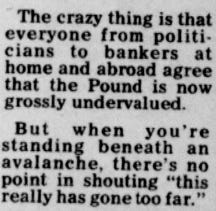
Things got so bad that Chancellor Denis Healey and his eyebrows went on television to tell everyone not to panic, which no doubt caused many viewers to realise that they were supposed to have been panicking all this time. The solution appears to be to accept that everything is going to have to get more expensive, but that your pay won’t be going up to compensate. No wonder my mum went back to work.
Now that Sir Harold Wilson is no longer offered the mild protection offered by his job title, some national newspapers have brought their barely concealed antipathy fully into the open. The issue revolves around his resignation honours list, which certainly raised a few eyebrows at the time, but prompted The Times and The Sunday Times to make direct allegations of impropriety, and to assert that the list had been drawn up, not by Sir Harold, but by his secretary, Marcia Williams, Lady Falkender5.
Some of the names on the list seemed unlikely, even to neutral observers, but once there had been widespread insinuations in the Times publications, every paper in the land felt free to weigh in with ‘we always knew there was something fishy going on’ stories. Most of this passed me by at the time, but it became notorious over time, so is another of those stories which I seem to have always known about. It’s illuminating to read how it unfolded in real time, so to speak.
The third story which preoccupied particularly the Scottish papers was a jailbreak from Peterhead prison:

Three prisoners, described as ‘dangerous’ and ‘a risk to the public’ managed to cut their way through an electrified fence on Tuesday afternoon and disappear. This provided an entire news cycle of breathless excitement with words like ‘manhunt’ being bandied about.
The whole thing lasted 36 hours before the three, in a stolen car, tried to escape a roadblock a few miles north of Peterhead only to lose control of their vehicle which “somersaulted down a 12ft. drop” according to the Evening Express.
Considering the somewhat flimsy construction of most 1970s cars, there seem to have been remarkably few injuries to the occupants, and all three were safely back in their cells in short order. The excitement of something I had only ever experienced in films happening just up the road again seems to have passed me by - I wonder if I was engrossed in exams at this point, or if I just wasn’t reading the papers with no football on the back pages.
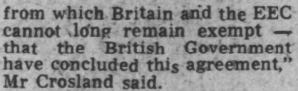
In other news, the Cod War deal was finally signed, bringing to an end several years of disagreement and the occasional potshot. The UK agreed to recognise a 200-mile exclusion zone around Iceland which British trawlers will only be allowed to fish in strictly limited quantities. This being what Iceland had been demanding from the beginning, you might be forgiven for thinking that this was an ignominious defeat for Britain.
And you’d be right, to be honest. Even Foreign Secretary Tony Crosland struggled to come up with any positive spin:

Was there any positive news this week?
Well, the Scottish Liberal Party wants to do away with the idea of there being a leader:
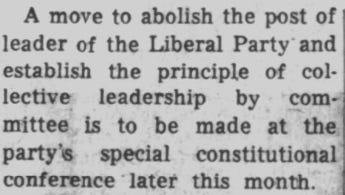
Presumably no-one involved with this had seen Monty Python and the Holy Grail.
Oh, and The Who played Celtic Park and attracted one of the biggest attendances in recent years as well as the inevitable Sunday Post headline:

More of this nonsense next weekend.
Club sides are strictly forbidden from playing national teams, so this is some kind of fudge. It’s not clear to me who forbids these things from happening, but Alex Cameron in the Daily Record on Saturday assures me it’s against some rule or other.
North American Soccer League, the over-hyped predecessor of the MLS, which featured a large number of older players from Europe and South America looking for one last payday. How very different from the current setup.
The Derby was run on a Wednesday for several decades after this; I don’t remember when it switched to Saturday, someone will know.
Spoiler - it was Celtic
Williams’ role in Wilson’s life was far more than the word ‘secretary’ can convey - a footnote in here can't possibly do her justice.