
Trans-Europe Express
Something to look forward to, at least.

Saturday July 10 1976
Let’s start with the obvious - nothing much happened in Scottish football this week. In fact, my handy Green Final guide to the previous week’s events contains only a couple of items:
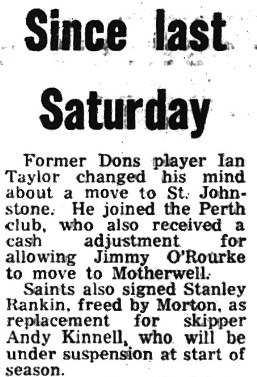
Fortunately, there was one other thing going on this week, and it involved four of the Premier Division teams, even if it didn’t involve anyone actually kicking a ball.
On Tuesday, the draw for the first round of the three UEFA club competitions was made. You’ll remember that four Scottish teams will be in Europe this season; Rangers in the European Cup; Hearts1 in the Cup -Winners’ Cup, and both Celtic and Hibs in the UEFA Cup.
The Scottish press generally considered themselves content with the draws - Rangers were expected to brush aside FC Zürich, the Swiss champions - the Scotsman noted their convincing league win last season, but concluded that:
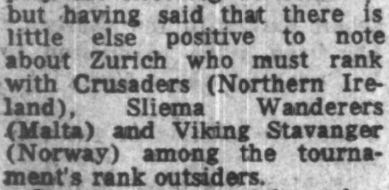
Hearts’ job in the Cup-Winners’ Cup is rated as somewhat more difficult, as they will be travelling behind the Iron Curtain to face Lokomotive Leipzig, a team from East Germany never far from the word ‘crack’ in any newspaper description2.
In the UEFA Cup, Celtic drew Wisła Kraków, who were skipped by in all the papers’ descriptions of the draw; a sure sign that a more honest report might have read “never heard of them; we assume Celtic will beat them.” Hibs’ reward for finishing third was a tie against Sochaux, who were presumably a little easier to research, and were considered not up to the Edinburgh side’s standards. No-one seems to have remembered the Scottish champions going out to French opposition last season, but to be fair, the general tone of reporting on European draws was derived from the fact that Scottish teams had won two of these competitions within the last ten years, so we should fear no-one.
A couple of procedural things caught my eye, because of course they did.
Firstly, as drawn, both Glasgow teams will be at home on the same night for the first leg, and both Edinburgh teams will be at home for the second leg. The Scotsman is concerned about the second of these, but probably not for the reason you might expect.
Rangers and Celtic at home on the same night should pass by without issue, although I wonder if Strathclyde Police had an opinion on that, but the two Edinburgh teams competing on the same night… well, here’s the argument:
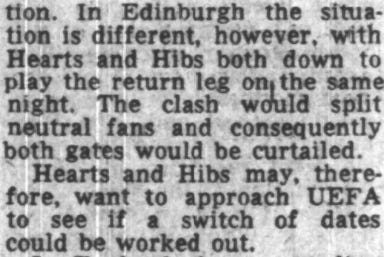
Now, before I commence shaking my head at this, I will stipulate that I did once attend a European game at Easter Road as a neutral3, so I’m not saying that never happened, but in a city with two well-supported senior clubs, my lived experience suggests that this crowd of neutrals who go to both Hibs and Hearts games was somewhat mythical.
The games are scheduled for mid-September, so we’ll see what happens between now and then.
The other thing which detained me was that I remember there being preliminary rounds in Europe, and wanted to see what the rules were, and what was going on there.
In 1976, there were exactly 33 member associations in UEFA4, and the rules around qualifying for the competitions was reasonably straightforward. First of all, you have to discard Wales from the European and UEFA Cups, as they did not have a professional league structure at the time, although the Welsh Cup winners got in to the Cup-Winners’ Cup. Then you had to discard Albania from all three competitions, because Albania didn’t hold with interacting with the outside world at this time. No, really.
After that, you factor in that the previous season’s winners automatically qualified for this year’s competition, unless they had qualified for a higher competition in the meantime, in which case - look, try to keep up - their place went to the next most qualified team from their country.
Where that leaves us is as follows: in the European Cup, there were 31 league champions in the draw, plus Bayern Munich as holders, which neatly gives 16 first-round ties.
In the Cup-Winners’ Cup, there were 32 national cup champions5 in the draw, but adding Anderlecht as holders rather spoiled that, so - as usual in this competition - there was one randomly drawn6 preliminary round. This year, Cardiff City will be playing Servette of Switzerland for the right to face whoever wins the Soviet Union Cup7.
In the UEFA Cup (and I’m really not sure I knew this at the time), there was a sliding scale of eligibility, so it wasn’t just a case of all 31 eligible associations getting two places; the largest nations (England, West Germany and Italy) got four spots, three nations got three, the seven smallest nations got one place, and everyone else got two.
I’ll admit, that surprised me a little, as I didn’t remember the handicap system where big countries got more spots being a thing until much later.
Anyway, having allocated places in the draw to the various associations, it was - up to a point - left to those individual members to decide how teams could qualify for the UEFA Cup. Some leagues simply gave their spots to the second-placed, third-placed and so on in the league; some (including England) had a second cup competition, so the winners of that could have a place, and some in years to come would organise end of season playoffs for these places.
The upshot of that was that - for example - 7th placed in the Bundesliga Kaiserslautern were in the UEFA Cup draw thanks to West Germany being successful enough that the top three had already qualified for one of the other two competitions.
My one remaining question about this whole thing is whether the Scottish League Cup winners would have taken one of the UEFA Cup spots - I think so, but since Rangers won the treble, and runners-up Celtic also qualified as league runners-up, it would have made no difference. If anyone else can muscle their way on to the podium this year, maybe we’ll find out8.
The only other oddity of the draw was that it contained a couple of either/or alternatives; both the Yugoslav and Soviet Cup competitions were yet to be completed, so Lierse of Belgium, for example, were drawn against “Yugoslav team”.
Simpler times, I’m sure you’ll agree.
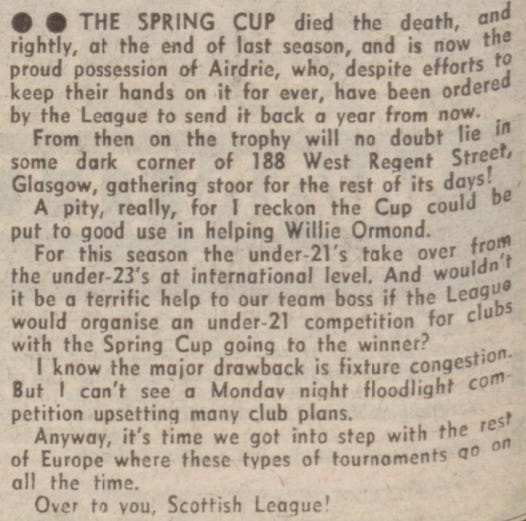
The rest of the week was entirely focused on the golf (see below), but the bold Doug Baillie in the Sunday Post still had one outstanding thing to worry about from the end of last season:
The vast majority of the sports pages this week were devoted to golf: it was the week of The Open (never the British Open, thanks) at Royal Birkdale, and - partly, as I remember, because of it being wall-to-wall on television through the week - all papers were filled with golf stories, even on the non-sports pages; the Daily Record sent Arnold Palmer up in a biplane for some reason.
As with Wimbledon at the time, no sports were played on a Sunday, so the final round was on Saturday afternoon, and the whole nation watched, enthralled, as Johnny Miller held off the challenge of.. well, let the Sunday Post tell the story:
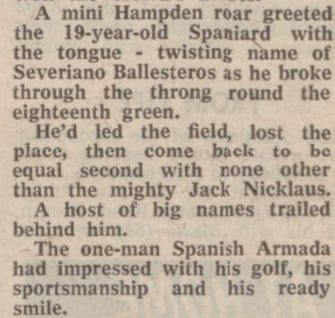
The odd paragraph which wasn’t devoted to the Open noted that the Olympics start next week in Montreal, and it’s set to be the most inclusive Games of all time, with absolutely no political issues surrounding it at all.
Well, some African nations are unhappy about New Zealand taking part after their rugby team played in pariah state South Africa, but I’m sure that will all blow over once the sport gets under way.
Oh, and the IOC has threatened to cancel the games entirely if Canada don’t allow the Taiwanese delegation to enter the country, but I’m equally sure that’s just a minor misunderstanding.
On the front pages, it was quite a week, which I’ll try to summarise as best I can:
Firstly, the weather continues to be ridiculously dry and hot. There’s not much to report in the area of emergency Government legislation (although it’s on the schedule to be discussed next week, if nothing more important comes up in the meantime), but it may be too late by then:
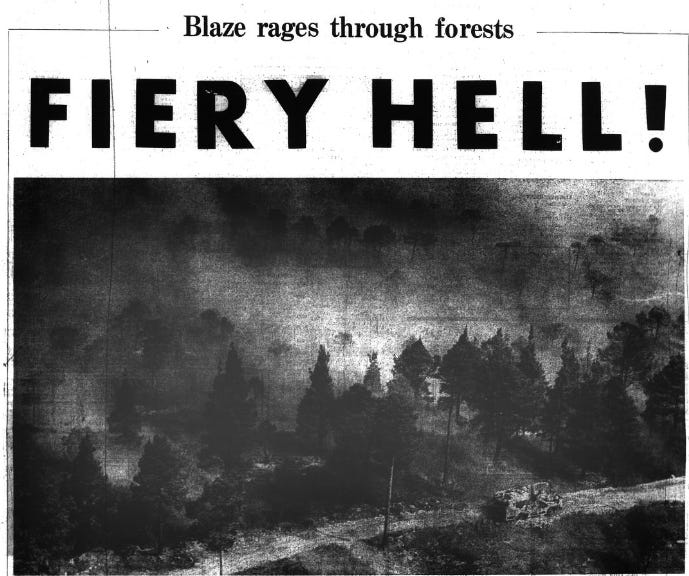
The Highlands are on fire, and there are suggestions that the rest of the country may follow suit. Fortunately, a sudden downpour did extinguish this particular blaze, but most of the country shows no sign of seeing rain any time soon.
The Liberal Party has a new leader - David Steel comfortably defeated John Pardoe in the ballot of members, and immediately united his party in - oh, wait; that’s not what happened:
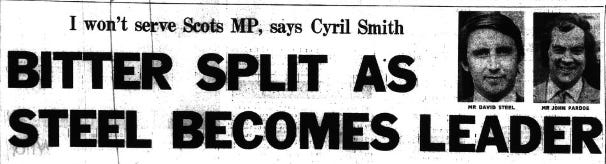
Essentially, the repulsive Cyril Smith threw his toys out of his enormous pram since the result didn’t go the way he wanted. Steel’s shrug was almost audible.
The big story of the week was the hijacking of a French airliner on its way from Tel Aviv to Paris. The original hijacking merited a few paragraphs last weekend; hijackings weren’t particularly noteworthy, as most of them were resolved fairly quickly, but this one took an unexpected twist when the hijackers diverted the plane to Entebbe airport in Uganda9.
As recounted in many books, films and other media, the Israeli government decided to mount an audacious rescue operation, which had newspaper editors scrambling to fire up their art departments to draw up diagrams and maps:
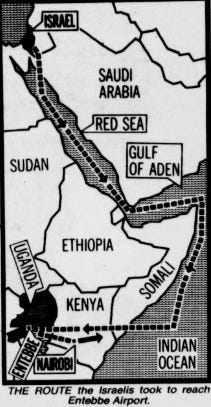
The details of the operation would emerge gradually, but the immediate concern was for one of the hostages, 74-year-old Mrs Dora Bloch, who had been taken to hospital in Kampala prior to the rescue, but who had subsequently disappeared. The Ugandan government, led by the dictator Idi Amin, declined to take any responsibility for her, claiming that they had taken her back to the airport before the rescue.
By the end of the week, the Daily Record was confidently asserting that Mrs Bloch had been killed by the Ugandans, but there was no concrete evidence either way. Idi Amin has been a figure of fun in the British press up to now; perhaps this will encourage people to notice that he is actually a dangerously unstable lunatic.
Finally, a quick note that, following the successful US Bicentennial celebrations, the Democratic Party was ready to hold its convention and anoint Jimmy Carter, Governor of Georgia, as its candidate for the general election in November. Governor Carter is reported to have been interviewing potential Vice-President candidates, including former astronaut John Glenn, this week, but no announcement is likely before next week’s convention.
It sounds as though qualifying to be a Vice-Presidential candidate is almost as complicated as qualifying for the UEFA Cup. Thank goodness these things are much simpler fifty years on…
By virtue of being runners-up in the Cup Final.
As in ‘crack East German outfit’, not anything drug-related.
Hibs beat Videoton of Hungary in the UEFA Cup in September 1989, and I went for some reason I cannot recall now. Wikipedia claims that Aberdeen played Rapid Vienna the same night, but I know that not to be true, as I went to both games. Indeed, the UEFA website confirms that Aberdeen played the following night, but I don’t remember why.
No, I’m not listing them - you can look it up for yourself if you’re interested.
Or runners-up, see Hearts for details.
I’m not certain that the really big names would have come out of the hat for this round, but I can’t prove that.
Yup, I’m coming back to that, too.
No spoilers, please.
At which point, you and I both exclaimed “oh, it’s that story”